
Real Madrid's Buy-Back Clause Blocks Barcelona From Signing Victor Muñoz
Authored by betbonus.asia, 15-04-2026
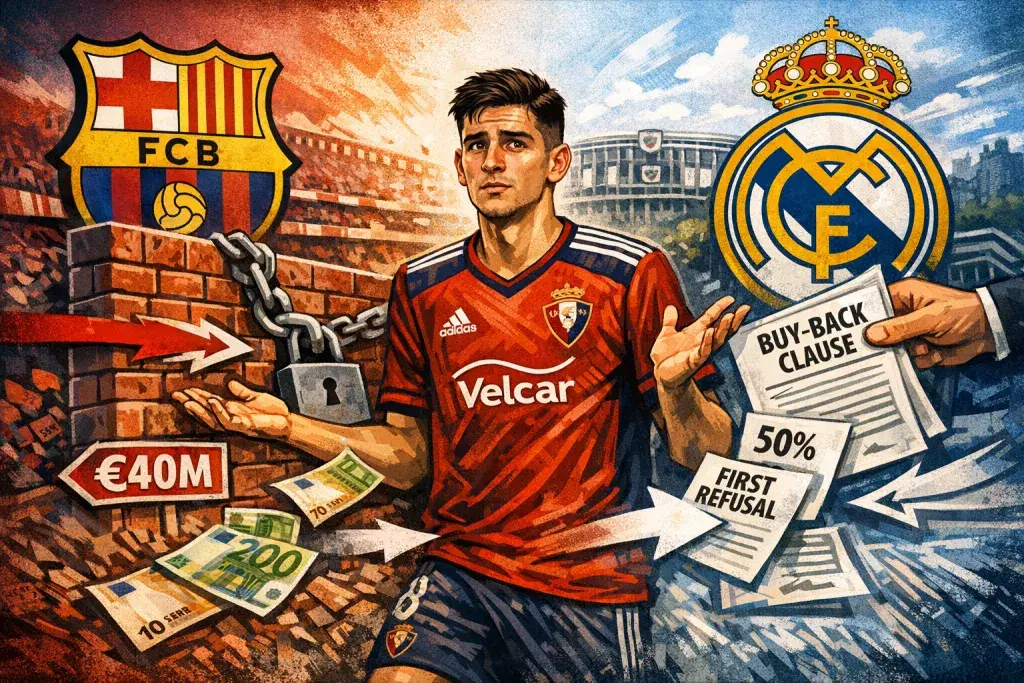
FC Barcelona's pursuit of Victor Muñoz has run into a wall built not by the 22-year-old himself, nor by Osasuna, but by Real Madrid — a club with whom the winger has no current contract, yet over whom he has surprisingly little freedom. A buy-back clause, a right of first refusal, and a 50% sell-on share have combined to give Real Madrid effective veto power over one of the most intriguing young talents in Spanish football right now.
How Real Madrid Controls a Player They No Longer Own
When Muñoz left Real Madrid's academy setup to join Osasuna in the summer for a fee of €5 million, the transfer appeared clean and straightforward. It was not. Real Madrid retained a buy-back option valued at €8 million — exercisable over the next three years, with the fee increasing by €1 million per season. That means the club could re-acquire him this summer for €8 million, next summer for €9 million, and the summer after that for €10 million. By any measure, those figures sit well below his apparent market value.
The protections do not stop there. Real Madrid also hold a 50% stake in any future transfer profit and a right of first refusal — meaning that if any club triggers the mandatory release clause of €40 million, Real Madrid retain the legal right to step in and match that offer. In practical terms, Barcelona cannot sign Muñoz without Real Madrid either waiving their protections voluntarily or choosing to act on them first.
This kind of contractual architecture is not unusual in Spanish football's transfer market, particularly where academy-developed talents are concerned. Clubs that invest years of development in a young footballer routinely negotiate these protections before allowing departures. What makes this case striking is the identity of the parties involved — and the fact that Muñoz was born in Barcelona and began his career at La Masia, only to leave at age nine in 2017 before eventually finding his way into Real Madrid's youth system via CF Damm four years later.
A Career Arc That Defies Simple Narratives
Muñoz's biography is unusual. Raised in Barcelona, trained at La Masia in his earliest years, then developed through Real Madrid's academy — his career has straddled the two greatest institutional rivalries in Spanish football before he has even turned 23. His path from Damm, a modest Catalan club, to Madrid's elite youth infrastructure is itself a reminder of how aggressively the major clubs monitor and recruit throughout Spain.
His debut senior season at Osasuna has been difficult to ignore. Across 33 appearances in all competitions, Muñoz has recorded six goals and five assists in 2,496 minutes of action — figures that translate to consistent direct involvement in chance creation and finishing at a high level of competition. For a 22-year-old in his first full senior campaign, that output has drawn attention well beyond Spain's borders. Premier League and Serie A clubs are also understood to be monitoring his situation closely.
His March debut for the senior Spanish national side, in which he scored in a 3–0 victory over Serbia, accelerated the speculation significantly. A place in Spain's squad for this summer's World Cup now appears within genuine consideration. International recognition at this stage only amplifies the stakes of any transfer decision.
What This Means for Barcelona — and for Muñoz
For Barcelona, the situation illustrates a broader vulnerability in how the club approaches the market for homegrown talent it once let go. Muñoz left La Masia as a child; the club has no contractual claim on him. Any bid to bring him back must navigate protections built by a rival institution, at a price Real Madrid controls and can adjust at will.
The mandatory release clause of €40 million offers a theoretical path — but only if Real Madrid decline to exercise their right of first refusal, which they have little incentive to do if the purpose is to prevent the transfer to Barcelona specifically. The buy-back option, by contrast, gives Real Madrid the far cheaper route of simply re-signing him outright, regardless of Barcelona's interest.
For Muñoz himself, the situation is a reminder that young professionals navigating career decisions can find their options significantly constrained by agreements made at earlier stages of their development. His immediate future may ultimately be decided less by his own preference or Osasuna's willingness to sell, and more by the strategic calculations of a club he no longer represents.